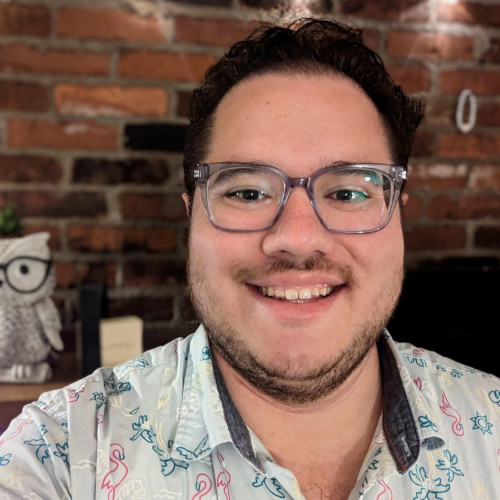
I am a Teaching Assistant Professor of Biological Sciences at the University of Pittsburgh, teaching and mentoring undergraduate and graduate students in computational biology. My research spans electrons, molecules, proteins, and genomes. I write software, run simulations, and train machine learning models to make sense of it. What drives most of it: accessible tools and knowledge for people who don’t start with an advantage, whether that’s a student without lab experience or a lab without a supercomputer.
What is tortoise mode?1
1 Brief timeline
- Started at Western Michigan University with no plan beyond “pick something marketable.” Chemical engineering won.
- Dr. Brian Young pointed me to the LSAMP program. That conversation changed everything.
- Two years of undergraduate research led to a PhD at Pitt with Dr. John Keith: quantum chemistry, solvation modeling, and machine learning force fields.
- Teaching/research postdoc with Dr. Jacob Durrant. Moved into computational structural biology and computer-aided drug design.
- Now: Assistant Teaching Professor at Pitt, training students to reason from fundamentals across disciplines.
- Along the way: High-performance computational tools where reproducible science is at the forefront.
Footnotes
Anita is my adopted grandma. She can’t travel to see the real Galápagos tortoises, and she keeps a collection of tortoise statues she loves. I visit her most weeks and sit beside them. Tortoise mode is for her. Turn it on and a small tortoise lives on the page: it walks the whole way over to your cursor to be near you, grazes and dozes and bobs its head between wanders, and tucks into its shell if you move too fast beside it.↩︎